
Building a foreign trade website isn't hard, but getting foreigners to place orders is challenging. The issue isn't the product—it's whether your official website is truly designed for global users. Cross-border website customization isn't just translation plus templated templates; it's a systematic reconstruction—from technical architecture to brand language.

90% of cross-border website projects fail to meet expectations—not because the technology is inadequate, but because they never aligned with clear objectives from the outset. We’ve dissected the logic behind truly effective evaluations: technical adaptability must serve business outcomes, otherwise even the most beautiful interface is just decorative.

Traditional CRM is slowing down your deal-closing speed. AI-driven CRM boosts lead conversion efficiency by over 35% through real-time intent recognition and intelligent decision-making. Next, we’ll break down how it works.

Choosing the wrong system results in an average annual loss of 15%-20% of orders. Using the right foreign trade CRM, conversion rates can increase by 87% within six months. This article breaks down five core criteria, revealing which technical indicators truly determine long-term returns.
Over 70% of multilingual websites struggle with sluggish growth—the problem lies not in translation, but in mismatches between underlying architecture and localization logic. Translation is not equal to localization; true breakthroughs in going global require dual adaptation—both technological and cultural.

AI customer management systems are no longer mere automation tools—they're new engines driving enterprise growth. They turn every interaction into a conversion opportunity. From data integration to intelligent decision-making, we break down the path to truly effective AI CRM implementation.

When standard template-based website building can no longer support complex business workflows, multilingual customer acquisition needs, and private domain accumulation, foreign trade enterprises must initiate custom foreign trade independent site development. Evaluating whether to upgrade from a standard site to a custom implementation hinges on determining if the existing website has become a bottleneck for customer acquisition and conversion, as well as whether future proprietary customer acquisition systems and AI CRM plans require deeper underlying data integration.
70% of B2B cross-border procurement begins with a search engine. But why is your foreign trade website’s traffic drying up? The problem isn’t keywords—it’s whether buyers really ‘understand’ you. This article breaks down technical barriers, content strategies, and ROI validation, guiding you toward building a compounding global customer acquisition engine.
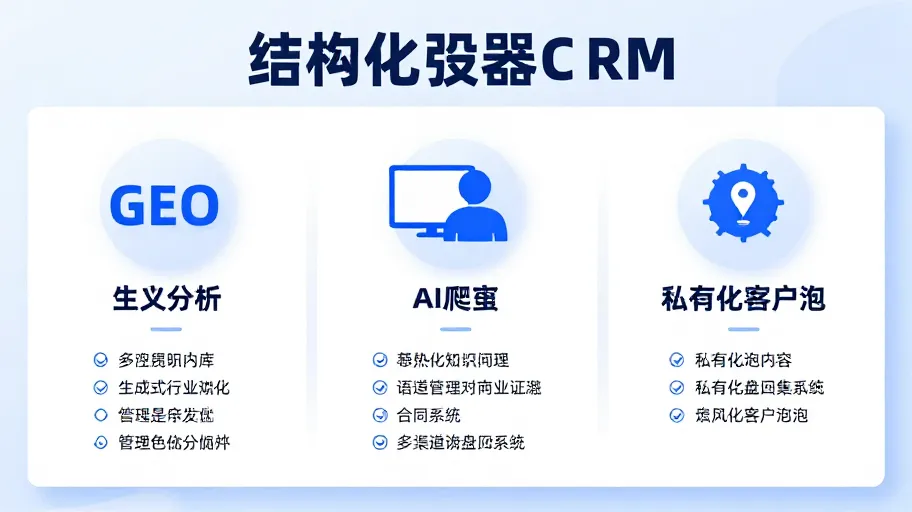
For enterprise AI lead generation to truly form a conversion loop, it cannot rely solely on a single traffic source or tool purchase. Instead, it must integrate the data flows of GEO (Generative Engine Optimization), AI CRM, and your own e-commerce independent site. For foreign trade enterprises aiming to build their own lead generation system, the core decision lies in assessing whether they possess the content infrastructure capable of handling AI-generated traffic, whether they can consolidate inquiries from multiple channels into a private customer pool, and whether they have the capability to feed marketing data back into the lead generation system for continuous optimization. The ultimate goal of this system is to transform passive waiting for inquiries into proactive lead generation capabilities that can self-iterate.